


WEBINAR #1: Production Systems for Industrialized Construction
Updated: Aug 26
ICG recently kicked off its webinar series Production Systems for Industrialized Construction webinar series with a focused conversation around a familiar challenge: How to scale production without scaling labor.
While labor is often the first constraint teams point to, the discussion quickly moved to something deeper—the production system behind it. In many prefabrication operations, work is still planned and managed using approaches rooted in field construction. Schedules drive activity; teams adapt in real time, and output often depends on heroics to bridge the gaps.
Those systems can deliver results, but they rarely scale with consistency. Over time, variability increases, coordination grows, and performance becomes harder to predict. What starts as a manageable amount of friction can quietly become your performance ceiling.
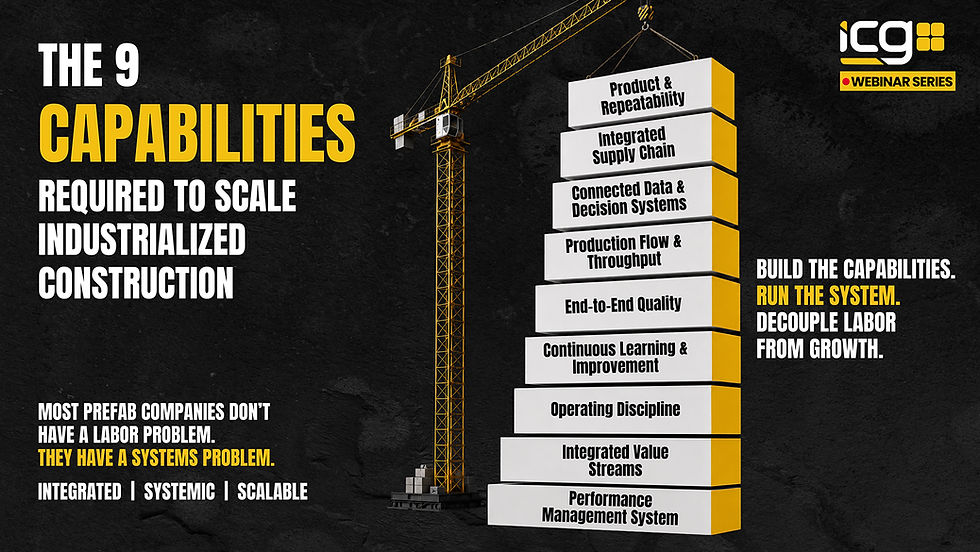
The IC Capabilities framework shared above - highlight the capabilities that enable production systems to perform consistently they scale. These capabilities are pulled from 3 years of ICG’s cross-industry Industrialized Construction Maturity Assessment (ICMA®) data. What does our data tell us? For traditional construction trade partners – 2 of these capabilities – Production Flow and Throughput and Performance Management - are at very low levels of maturity.
But this is good news – because these capabilities are in our control!
The Prefab leaders beginning to break through are shifting focus and addressing these capability gaps. Instead of trying to push more output from the same conditions, they are stepping back and looking at how their production system itself is designed. That shift—from managing work to designing a production system—introduces a different set of priorities: clearly defined work content, intentional production flow, balanced labor aligned to the system, and visibility into performance as it happens. These are not standalone improvements. The system ultimately performs at the level of its weakest constraint – and these core elements of production system design and operation are holding us back.
As industrialized construction continues to grow—particularly across data centers, healthcare, and housing—the importance of this shift is becoming more visible. The challenge is no longer just adding capacity. It’s doing so while maintaining quality and predictability and navigating a rapid pace of design improvements.
That leads to a different question than most teams are used to asking:
Are we managing work—or are we running a production system?
The first session was designed to establish that foundation. From here, the conversation begins to move deeper into how these systems are actually defined and run, starting with the transition from drawings to clearly defined work content.
Because, until work is understood at that level, the rest of the system—flow, labor balance, and performance will continue to rely on individual heroics rather than a system designed for manufacturing success.
For many teams, this isn’t a new problem. It’s a reframed one. And it’s where meaningful progress starts.


